The Off-Season Reckoning: What Your Slow Months Are Really Telling You About Your Business
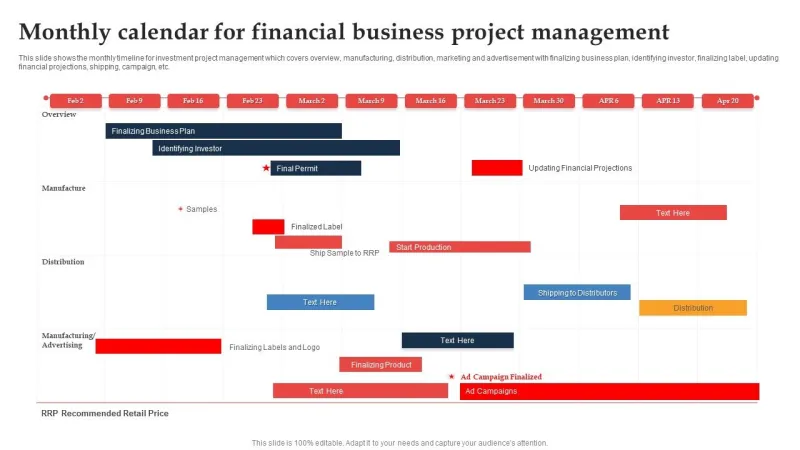
Photo: seasonal business planning financial review calendar SME owner, via www.slidegeeks.com
When Good Months Cover for Bad Habits
Ask the owner of a seasonal business how things are going in July, and the answer is often enthusiastic. Revenue is strong, the team is busy, cash is flowing. Ask the same question in February, and the conversation takes a very different tone. The bills haven't changed. The lease is the same. Payroll continues. But the customers have largely disappeared.
This is the seasonal squeeze—and for thousands of American SMEs in industries ranging from landscaping and tourism to retail and construction, it is a recurring source of financial stress that never quite gets resolved. Instead, it gets survived. The busy season generates enough cash to carry the business through the lean months, and by the time the next peak arrives, the cycle resets without any of the underlying dynamics being examined or addressed.
The danger in this pattern is not just cash flow volatility. It is the way that seasonal revenue spikes systematically conceal structural inefficiencies that, in a year-round business, would be impossible to ignore. For seasonal operators, the good months don't just fund the slow ones—they fund the mistakes, the bloat, and the operational drift that accumulates when no one is scrutinizing the numbers closely enough.
The Normalization Problem
One of the most consequential analytical errors seasonal business owners make is evaluating their financial performance through the lens of their best months. When a summer resort operation reviews its profit and loss statement for June, July, and August, the margins look healthy. Labor costs as a percentage of revenue appear manageable. Fixed overhead seems proportionate. The business, on paper, looks like it is working.
The picture changes dramatically when those same fixed costs are distributed across twelve months rather than three. A business that appears to operate at a 20 percent profit margin during peak season may actually be running at a structural loss once the full year's cost base is factored in. Owners who do not perform this normalization exercise regularly are, in effect, making strategic and operational decisions based on a fundamentally misleading financial picture.
Normalizing seasonal financials requires spreading fixed costs evenly across the full operating year—regardless of when revenue is earned—and then comparing that annualized cost structure against realistic annual revenue projections. The result is often sobering. It reveals the true break-even point that the business must sustain across all months, not just the peak ones, and exposes how thin the actual margin for error really is.
Fixed Versus Variable: The Distinction That Changes Everything
At the core of any meaningful seasonal financial analysis is a rigorous separation of fixed and variable costs. This distinction sounds straightforward but is routinely misapplied in practice, often because business owners classify costs based on how they are billed rather than how they actually behave.
A staffing agency that provides seasonal labor on a per-hour basis appears to be a variable cost. But if the business cannot operate without a minimum crew size regardless of revenue volume—if slow-season staffing is effectively a floor rather than a flexible input—then a portion of that labor cost is functionally fixed and should be treated as such.
Conversely, certain costs that appear fixed often have more flexibility than owners assume. Commercial leases, equipment rental agreements, and service contracts are frequently negotiable, particularly when a business can demonstrate a long-term relationship and a credible case for restructuring terms. Owners who have never tested the flexibility of their fixed cost base may be carrying obligations that could be reduced with a direct conversation.
Mapping costs accurately into fixed and variable categories—and then stress-testing that map against low-revenue scenarios—gives business owners a clear picture of what the business genuinely requires to survive its worst months. This is the number that matters most for long-term planning, yet it is the number that seasonal businesses most frequently fail to calculate.
What the Slow Season Is Actually Diagnosing
Beyond cash flow stress, the slow season serves as an involuntary diagnostic. When revenue drops and the margin for inefficiency disappears, the operational problems that were invisible during the peak period become impossible to ignore.
Overstaffing that was masked by peak-season busyness becomes obvious when those employees have little productive work. Inventory management systems that were adequate at high volume break down when slower turnover exposes their limitations. Customer service processes that worked when staff were fully engaged reveal their fragility when reduced teams are stretched across multiple responsibilities.
Business owners who treat the slow season purely as a financial problem to be endured—rather than an operational diagnostic to be analyzed—miss its most valuable function. The lean months are the truest test of organizational efficiency. A business that runs well in February is a business that runs well. A business that only runs well in July is a business that has been subsidizing its own inefficiencies without realizing it.
Building Revenue Resilience Without Abandoning Your Model
For many seasonal businesses, the instinctive response to slow-season pressure is to pursue off-season revenue streams. A landscaping company offers snow removal. A beach resort promotes winter retreat packages. A summer camp develops adult programming for the fall.
These strategies can be effective, but they carry their own risks if pursued without structural discipline. Diversifying into off-season revenue lines requires additional investment in marketing, staffing, and often equipment or facilities. If those investments are not evaluated against the true cost of execution—including the management attention they consume—they can generate revenue while actually reducing overall profitability.
A more durable approach to building resilience begins not with adding revenue but with reducing the business's vulnerability to revenue absence. This means identifying which fixed costs can be restructured as genuinely variable, building cash reserves during peak months through disciplined allocation rather than reinvestment of every dollar earned, and establishing credit facilities during high-revenue periods when lenders are most favorably disposed—not during the slow season when the need is urgent and the negotiating position is weakest.
The Annual Reset That Most Owners Skip
At the conclusion of each peak season, before the relief of a strong year has fully settled in, business owners should conduct a structured performance review that specifically separates seasonal performance from underlying business health. This review should address three questions.
Did the business generate enough peak-season cash to cover its full-year cost structure with a meaningful buffer? If not, the cost structure—not the revenue—is the primary problem to solve.
Which operational problems were exposed during the slow season, and what systemic changes would prevent them from recurring? Treating slow-season pain as a recurring cost of doing business rather than a solvable problem is a choice with compounding consequences.
What does the business need to look like financially to be sustainable in its worst month? That answer should drive planning decisions for the year ahead—not the optimism of the best month on record.
Seasonal businesses are not inherently fragile. But they are uniquely susceptible to the illusion of health that strong months create. The owners who build lasting enterprises are those who refuse to let a good summer convince them that the business is stronger than it actually is.